Different types of cars explained
Different types of cars explained

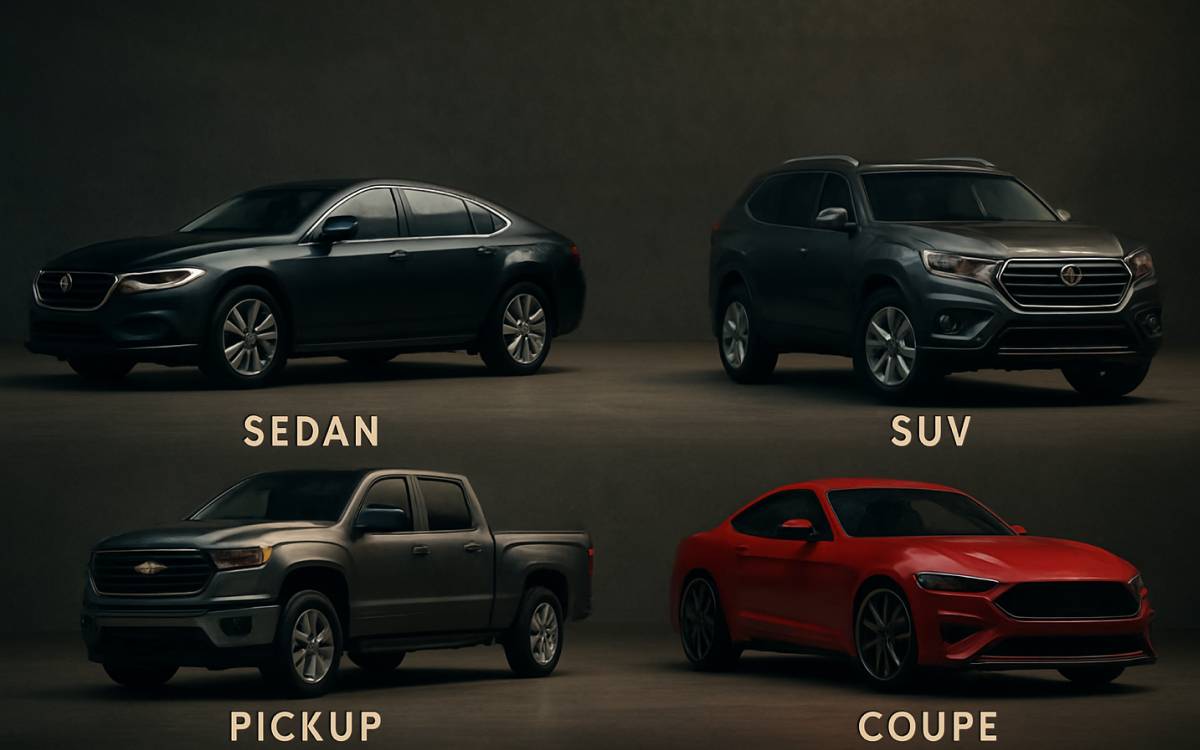
When buying a car, the first thing one needs to decide is which type is suitable. Cars can be classified into numerous types based on their size, body design, seating capacity, engine performance, and other features. The sheer number of options in the market can make the car-buying process exciting and intimidating in the same measure. Knowing the different types of cars before heading to a dealership can help one make better decisions.

Hatchbacks

These cars have a compact body with a rear door that opens upward. They have a two-box design, comprising an engine bay and a combined passenger and cargo area). Hatchbacks are typically less than four meters long. Their small size and low center of gravity make maneuvering easy, especially in tight spaces.

Pros

  • Fuel-efficient because of its small size and light weight
  • Easy to park
  • Ideal for use in high-traffic urban settings
  • Affordable pricing

Cons

  • Limited trunk capacity
  • Limited legroom, especially for rear passengers

Examples

Honda Civic, Mazda Mazda3, Volkswagen Golf GTI

Sedans

These cars have a three-box design, comprising an engine bay, a cabin, and an extended trunk). They are longer than hatchbacks and offer more legroom. Sedans generally prioritize ride quality, balanced performance, stability, and sound insulation over rapid acceleration.

Pros

  • Comfortable ride
  • Refined interiors
  • Better passenger safety compared to hatchbacks
  • More trunk space than hatchbacks

Cons

  • Less-adaptable cargo area
  • Difficult to park and maneuver due to an elongated body

Examples

Toyota Camry, Honda Accord, Nissan Sentra

SUVs 

Sports utility vehicles (SUVs) are large cars that can seat five or more passengers. They have a higher ground clearance, a commanding driving position, and two to three spacious rows of seats with sufficient legroom, shoulder room, and headroom. There are many subcategories within the SUV classification, including compact SUVs, full-sized SUVs, and sports activity vehicles. Compared to sedans and hatchbacks, SUVs are more rugged.

Pros

  • Ample passenger and cargo space
  • Better external visibility for passengers than in sedans and hatchbacks
  • Useful for driving on rough terrain
  • Versatile cargo configuration
  • More purchase options given the different SUVs subcategories

Cons

  • Lower fuel economy than hatchbacks and sedans
  • Higher purchase prices
  • Difficult to park and maneuver in tight corners due to a larger body

Examples

Toyota RAV4, Honda CR-V, and Chevrolet Equinox

Station wagons

These vehicles are a cross between sedans, SUVs, and hatchbacks. Their roof tapers toward the back to include the trunk within the cabin area. Station wagons combine sedan-like stability with the space, comfort, and daily practicality of SUVs. Unlike SUVs, they are not bulky, making them better suited to urban driving.

Pros

  • Large cargo area
  • Lower ride height than SUVs for easier handling
  • Better fuel efficiency than SUVs

Cons

  • Not as aesthetically pleasing as sedans
  • Fewer options than hatchbacks, sedans, and SUVs

Examples

Volvo V60, Audi A4 Allroad, Subaru Outback

Sports cars

Sports cars are the most expensive of all the types of vehicles on this list. They are built for high performance, better acceleration, and precise ride and handling. Sports cars are available as hatchbacks, sedans, coupes, SUVs, and in other body types. They come with powerful engines, bold styles, and loads of features and safety equipment.

Pros

  • Exciting driving experience
  • Powerful acceleration
  • Distinctive design
  • Sharp handling

Cons

  • Expensive to buy, maintain, and insure
  • Limited boot space and practicality
  • Lower fuel economy

Examples

Porsche 911, Chevrolet Corvette, Ford Mustang

Convertibles

These cars come with a retractable or removable roof, which allows one to enjoy the open air. Convertibles are usually associated with leisure driving. They also have a strong road presence. 

Pros

  • Stylish
  • Fun to drive
  • Powerful engines

Cons

  • Higher cost
  • Reduced trunk space
  • Increased road noise in the cabin
  • Less practical in rainy or snowy conditions
  • Less fuel efficient than sedans, hatchbacks, or SUVs

Examples

Mazda MX-5 Miata, Ford Mustang Convertible, BMW Z4

Besides these car body types, one may find minivans, coupes, roadsters, and limousines.

Recommended

6 things to consider when choosing all-terrain tires

6 things to consider when choosing all-terrain tires

All-terrain tyres are designed to handle different driving conditions. From paved highways to gravel roads, dirt tracks, and mild off-road terrain, these tyres can cover many bases. They are often chosen by drivers who need versatility rather than a tyre optimized for a single surface. Selecting the right all-terrain tyre involves understanding driving habits, vehicle requirements, and the environments the tyre is expected to perform in. A well-chosen tyre supports safety, durability, and consistent performance across changing road conditions. Driving conditions and usage When selecting all-terrain tires, a driver should first assess how and where the vehicle is used. All-terrain tires vary in how aggressively they are designed, and not all options perform equally across surfaces. Some vehicles are mostly driven on highways with little to no time on unpaved roads, while others regularly ride on rocky, sandy, or muddy paths with uneven terrain. An honest review of one’s driving habits helps avoid choosing tires that are too noisy for daily highway commuting or too weak for rugged off-road weekend adventures. Tread pattern and design The tire’s tread pattern plays a crucial role in how it performs. Tires with wide, deep treads handle dirt and gravel roads very well. Some are also designed to shake off dirt and gravel to maintain grip on rough and uneven ground.
Car financing options – Banks, dealerships, and credit unions

Car financing options – Banks, dealerships, and credit unions

When buying a car, the best thing is to pay the full amount upfront. This way, one becomes the owner immediately and avoids the risk of the car being repossessed. One also does not have to worry about monthly installments or interest charges. However, making a total upfront payment might not be possible if the vehicle is expensive and one has limited savings. In this case, looking into car financing options might be necessary. What is car financing? Financing a car means buying it by borrowing money. One can borrow enough money to cover the entire purchase or make a partial payment (down payment) on their own and use the borrowed amount for the rest. The outstanding sum, along with interest, must be paid back to the lender in monthly installments. Most auto loans are secured, meaning the car being bought serves as collateral for the loan. So, if one misses more than a set number of payments, the lender has the right to repossess the car and sell it to recover their money. They can also repossess and sell the car if one violates any loan agreement. Auto financing options Banks One can apply for an auto loan from a bank by visiting its website or a nearby branch.
6 key tips for selling a used RV

6 key tips for selling a used RV

Demand for RVs is at an all-time high due to remote work, tax refunds, and flexible travel. So, the process of selling a used RV can be simplified with significant time, research, and effort. One can choose to sell it through a dealer or by oneself. Additionally, the RV needs to be prepared for sale, which involves addressing repairs, creating listings, taking photos, and more. To simplify this process, having a checklist can be helpful.  Clean thoroughly Before listing a used RV for sale, ensure the vehicle is thoroughly cleaned for the next owner. Make sure to deep clean the RV, both inside and out. Use a pressure washer on all accessible surfaces, as this will ensure the exterior has a shiny, squeaky-clean look when complete. Do not overlook the carpet and any bedding; shampoo and vacuum them to remove all the trapped dirt and microbes. Make every effort to show buyers that the RV has been well-maintained. This process will help one get a decent value for the vehicle. Depersonalize When selling an RV, depersonalizing it is important. Remove all personal decor, furniture, bumper stickers, and anything else that reflects the previous owner’s personal touch and space. Essentially, the aim is to eliminate any visual reminders that the RV was previously used as a home, as potential owners need not be reminded of its past users.
Top 6 coupe cars in 2026

Top 6 coupe cars in 2026

For drivers seeking a combination of everyday comfort and sporty features, coupes are an excellent option to consider. The latest lineup features a wide range of cars, including affordable rear-wheel-drive sports models, sporty options, and upscale luxury vehicles. With so many options available, it can be confusing to make the right choice. So, learning about the top models, their key features, and prices can help one make an informed buying decision. Toyota GR86  This compact car features a 6.3-inch ground clearance, four seats, and 6.3 cubic feet of trunk space, making it suitable for those looking for a coupe for daily commuting. Under the hood, it is equipped with a 2.4L turbo flat-four engine that is capable of producing 228 horsepower and 184 lb-ft of torque. Buyers can choose between a 6-speed manual and an automatic transmission, both paired with rear-wheel drive. The car delivers a combined fuel efficiency of 22–24 mpg and comes with a Torsen limited-slip differential and a sport-tuned suspension. Inside, the cabin is fitted with an 8-inch touchscreen compatible with Apple CarPlay and Android Auto. The starting price is around $30,000. Subaru BRZ Like the Toyota GR86, this affordable coupe also features a 2.4L boxer engine that delivers 228 horsepower and 184 lb-ft of torque.